Choosing the Right Project: A Guide to Selection Methods
Making wise project choices can make or break your organization’s success. But with limited resources and countless opportunities, how do you pick the winners? This comprehensive mind map breaks down the key approaches to project selection.
The Big Picture
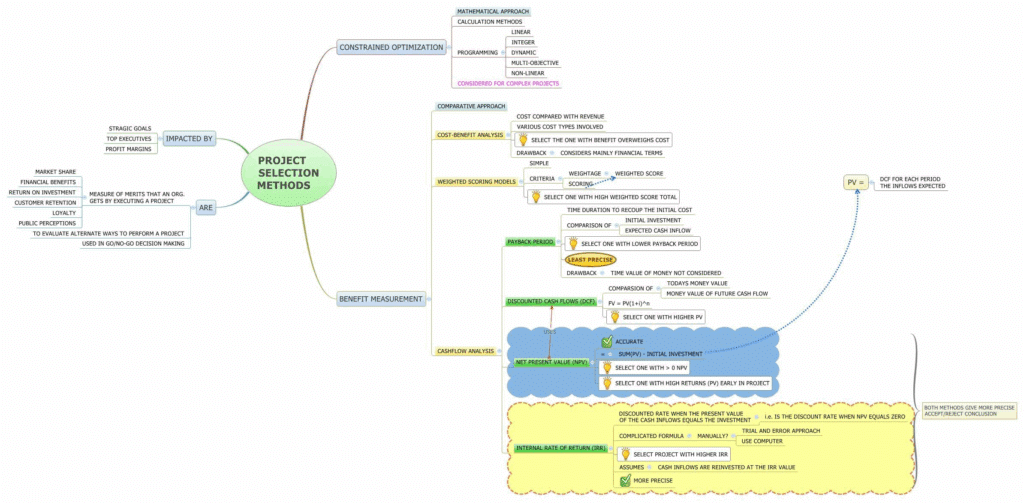
Project selection methods fall into several main categories, each serving different organizational needs and contexts. The choice depends on your goals, available data, and decision-making style.
Mathematical Precision vs. Strategic Comparison
Mathematical approaches offer quantitative rigor through methods like linear programming, integer programming, and multi-objective optimization. These work best when you have solid data and well-defined constraints. For complex scenarios involving multiple competing objectives, constrained optimization techniques help find the optimal balance.
Comparative approaches focus on relative evaluation through cost-benefit analysis and weighted scoring models. These methods excel when you need to rank multiple projects against common criteria, allowing decision-makers to weigh different factors according to organizational priorities.
Following the Money
Financial evaluation remains central to most selection processes. Key methods include:
- Payback Period Analysis – Simple but limited, focusing on how quickly you’ll recoup initial investments
- Net Present Value (NPV) – The gold standard for comparing projects with different cash flow patterns
- Internal Rate of Return (IRR) – Useful for understanding project profitability, though it requires careful interpretation
The NPV approach stands out for its accuracy in handling time value of money, making it particularly valuable for long-term strategic decisions.
The Bottom Line
Effective project selection isn’t about finding the “perfect” method—it’s about matching your approach to your situation. Use mathematical methods when precision matters and data is available. Turn to comparative approaches when strategic alignment and stakeholder input are crucial. And always ground your decisions in solid financial analysis.
Remember: the best project selection method is the one your organization will actually use consistently and trust in its decision-making process.