Network Pluggables & Interface Standards — Technical Reference
A practical cheatsheet covering pluggable form factors (SFP/QSFP/OSFP/CFP), Ethernet PHY standards, fiber types, connectors, DAC/AOC cabling, and adjacent ecosystems (InfiniBand, Fibre Channel, PoE).
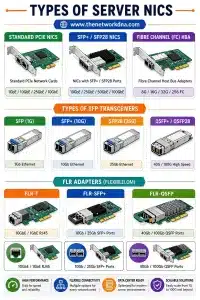
1. Pluggable form factors at a glance
| Form factor | Lanes × lane rate | Total bandwidth | Typical use | Connector / interface | Status |
|---|---|---|---|---|---|
| GBIC | 1 × 1G | 1 Gb/s | Legacy 1G | SC duplex | Obsolete |
| SFP (Mini-GBIC) | 1 × 1.25G (8B/10B) | 1 Gb/s | 1G access/uplink, also 100M & FC | LC duplex / RJ45 | Mature |
| SFP+ | 1 × 10.3125G | 10 Gb/s | 10G server/switch, 8/16G FC | LC duplex | Mature |
| SFP28 | 1 × 25.78G (NRZ) | 25 Gb/s | 25G ToR-to-server, 32G FC | LC duplex | Current |
| SFP56 | 1 × 53.125G PAM4 | 50 Gb/s | 50G server | LC duplex | Current |
| SFP-DD | 2 × 25/50G | 50 / 100 Gb/s | 100G servers backward-compatible | LC duplex | Niche |
| SFP112 / SFP-DD112 | 1×100G / 2×100G PAM4 | 100 / 200 Gb/s | Next-gen 100G server | LC duplex | Emerging |
| XFP | 1 × 10G | 10 Gb/s | Early 10G, larger than SFP+ | LC duplex | Obsolete |
| QSFP+ | 4 × 10G | 40 Gb/s | 40G uplinks / breakout to 4×10G | MPO-12 / LC | Mature |
| QSFP28 | 4 × 25G NRZ | 100 Gb/s | 100G uplinks / breakout to 4×25G | MPO-12 / LC | Mature |
| QSFP56 | 4 × 50G PAM4 | 200 Gb/s | 200G, 2×100G breakout | MPO-12 / LC | Current |
| QSFP-DD | 8 × 50G PAM4 | 400 Gb/s | 400G spine; backward-compatible with QSFP+/28/56 | MPO-16 / MPO-12 / LC | Current |
| QSFP112 | 4 × 100G PAM4 | 400 Gb/s | 400G, lower power than QSFP-DD | MPO-12 / LC | Emerging |
| QSFP-DD800 / OSFP | 8 × 100G PAM4 | 800 Gb/s | 800G AI/HPC fabric | MPO-16 / dual MPO-12 | Current (2024+) |
| OSFP | 8 × 50/100G | 400 / 800 Gb/s | Hyperscale, AI clusters; integrated heatsink | MPO / dual MPO | Current |
| CFP / CFP2 / CFP4 / CFP8 | 10 × 10G → 16 × 25G | 100 / 200 / 400 Gb/s | Coherent DWDM, telco | LC / various | CFP/CFP2 still in DWDM |
Backward compatibility: A QSFP-DD cage accepts QSFP+/28/56 modules (uses 4 of 8 lanes). An SFP+ cage usually accepts SFP modules at 1G. QSFP module will not fit an SFP cage (mechanically larger).
2. Lane rates & encoding
| Era | Per-lane rate | Encoding | Notes |
|---|---|---|---|
| 1G | 1.25 Gbaud | 8B/10B | 20% overhead → 1 Gb/s usable |
| 10G | 10.3125 Gbaud | 64B/66B NRZ | ~3% overhead |
| 25G | 25.78125 Gbaud | 64B/66B NRZ + RS-FEC (528,514) | FEC often required |
| 50G PAM4 | 26.5625 Gbaud × 2 bits | PAM4 + RS-FEC (544,514) KP4 | Mandatory FEC |
| 100G PAM4 | 53.125 Gbaud × 2 bits | PAM4 + RS-FEC KP4 | Lane of 800G/1.6T era |
| 200G PAM4 (1.6T era) | 106.25 Gbaud × 2 bits | PAM4 + FEC | Emerging, 2025+ |
PAM4 vs NRZ: PAM4 carries 2 bits per symbol (4 levels) → doubles throughput at the same baud rate, but with ~9.5 dB lower SNR. Always paired with stronger FEC.
3. Ethernet optical/copper standards
1 Gigabit (IEEE 802.3 — 1000BASE-X family)
| Standard | Medium | Wavelength | Reach | Connector |
|---|---|---|---|---|
| 1000BASE-T | Cat5e+ copper, 4 pairs | — | 100 m | RJ45 |
| 1000BASE-SX | OM1/2/3 MMF | 850 nm | 550 m (OM2), 1 km (OM3) | LC |
| 1000BASE-LX | SMF (or MMF w/ mode conditioning) | 1310 nm | 10 km | LC |
| 1000BASE-EX | SMF | 1310 nm | 40 km | LC |
| 1000BASE-ZX | SMF | 1550 nm | 70–80 km | LC |
| 1000BASE-BX | Single SMF (bidi) | 1310/1490 nm Tx/Rx | 10/20/40 km | LC simplex |
10 Gigabit (802.3ae and successors)
| Standard | Medium | Wavelength | Reach |
|---|---|---|---|
| 10GBASE-T | Cat6a/Cat7 | — | 100 m (55 m on Cat6) |
| 10GBASE-CR (SFP+ DAC) | Twinax copper | — | 1, 3, 5, 7 m passive; 10–15 m active |
| 10GBASE-SR | OM3/OM4/OM5 | 850 nm | 300 m OM3, 400 m OM4 |
| 10GBASE-LRM | Legacy MMF | 1310 nm | 220 m |
| 10GBASE-LR | OS2 SMF | 1310 nm | 10 km |
| 10GBASE-ER | OS2 SMF | 1550 nm | 40 km |
| 10GBASE-ZR/ZW | OS2 SMF | 1550 nm | 80 km |
| 10GBASE-BX | Bidi SMF | 1270/1330 or 1490/1550 | 10/20/40 km |
25 Gigabit (802.3by / cu)
| Standard | Medium | Reach |
|---|---|---|
| 25GBASE-T | Cat8 copper | 30 m |
| 25GBASE-CR / CR-S | Twinax DAC | 3 / 5 m |
| 25GBASE-SR | OM3/OM4 | 70 / 100 m |
| 25GBASE-LR | SMF 1310 nm | 10 km |
| 25GBASE-ER | SMF 1550 nm | 30–40 km |
40 Gigabit (802.3ba) — QSFP+
| Standard | Medium | Wavelength | Reach |
|---|---|---|---|
| 40GBASE-CR4 | Twinax (4 lanes) | — | 5–7 m |
| 40GBASE-SR4 | OM3/OM4 MMF, MPO-12 | 850 nm | 100 / 150 m |
| 40GBASE-eSR4 | OM3/OM4 | 850 nm | 300 / 400 m |
| 40GBASE-LR4 | SMF, CWDM (4 λ) | 1271–1331 nm | 10 km |
| 40GBASE-ER4 | SMF | 1310 nm band | 40 km |
| 40GBASE-LR / FR (single-λ) | SMF | 1310 nm | 2 / 10 km |
100 Gigabit — QSFP28 (and later QSFP-DD/OSFP single-mode variants)
| Standard | Medium | Reach | Notes |
|---|---|---|---|
| 100GBASE-CR4 | Twinax | 1–5 m | 4×25G DAC |
| 100GBASE-CR2 | Twinax | 3 m | 2×50G PAM4 |
| 100GBASE-SR10 | OM3/OM4 MPO-24 | 100 / 150 m | Legacy CFP/CXP |
| 100GBASE-SR4 | OM3/OM4 MPO-12 | 70 / 100 m | 4×25G NRZ |
| 100GBASE-SR2 | OM3/OM4 MPO-12 | 100 m | 2×50G PAM4 |
| 100GBASE-SR1 / SR1.2 | OM4/OM5 LC | 100 m | Single-lane 100G |
| 100GBASE-PSM4 | SMF MPO-12 | 500 m | MSA, not IEEE |
| 100GBASE-CWDM4 | SMF LC | 2 km | MSA |
| 100GBASE-DR | SMF LC | 500 m | Single λ 1310 |
| 100GBASE-FR | SMF LC | 2 km | Single λ |
| 100GBASE-LR4 | SMF LC, 4 λ | 10 km | Workhorse uplink |
| 100GBASE-ER4 | SMF LC | 30–40 km | Often needs SOA |
| 100GBASE-ZR | SMF LC | 80 km | Coherent in QSFP28 (rare) |
200 Gigabit — QSFP56 / QSFP-DD (2×100G)
| Standard | Medium | Reach |
|---|---|---|
| 200GBASE-CR4 | Twinax (4×50G PAM4) | 3 m |
| 200GBASE-SR4 | OM4 MPO-12 | 100 m |
| 200GBASE-DR4 | SMF MPO-12 | 500 m |
| 200GBASE-FR4 | SMF LC, 4 λ | 2 km |
| 200GBASE-LR4 | SMF LC, 4 λ | 10 km |
400 Gigabit — QSFP-DD / QSFP112 / OSFP
| Standard | Medium | Reach | Notes |
|---|---|---|---|
| 400GBASE-CR8 / CR4 | Twinax | 3 m | 8×50G or 4×100G PAM4 |
| 400GBASE-SR8 | OM4 MPO-16 | 100 m | 8×50G PAM4 |
| 400GBASE-SR4 | OM4/OM5 MPO-12 | 100 m | 4×100G PAM4 |
| 400GBASE-SR4.2 (BiDi) | OM4 MPO-12 | 70/100 m | 2 wavelengths per fiber |
| 400GBASE-DR4 | SMF MPO-12 | 500 m | 4×100G; pairs with 100G-DR |
| 400GBASE-FR4 | SMF LC, 4 λ | 2 km | CWDM-style |
| 400GBASE-LR4 | SMF LC, 4 λ | 10 km | LWDM |
| 400GBASE-ER8 / ZR / ZR+ | SMF LC | 40 / 80–120 km | Coherent (ZR/ZR+) |
800 Gigabit — QSFP-DD800 / OSFP
| Standard | Medium | Reach |
|---|---|---|
| 800GBASE-CR8 | Twinax 8×100G PAM4 | 2–3 m |
| 800GBASE-SR8 | OM4 MPO-16 | 50/100 m |
| 800GBASE-DR8 / DR4-2 | SMF MPO-16 / MPO-12 | 500 m |
| 800GBASE-FR4 / FR8 | SMF LC, 4 λ × 2 | 2 km |
| 800G-LR4 | SMF LC, 4 λ | 10 km |
| 800G ZR / ZR+ | SMF LC | 80–120+ km coherent |
1.6 Terabit (emerging, 2025–2026)
Based on 200G/lane PAM4. Form factors: OSFP-XD, QSFP-DD-1600 (under MSA), CPO (co-packaged optics) for hyperscale.
4. Fiber types & reach reference
| Type | Core / cladding | Color jacket | Wavelength sweet spot | Typical reach @ 10G/100G |
|---|---|---|---|---|
| OM1 | 62.5/125 µm MMF | Orange | 850/1300 nm | 33 m / not supported |
| OM2 | 50/125 µm MMF | Orange | 850/1300 nm | 82 m / not supported |
| OM3 | 50/125 µm laser-optimised | Aqua | 850 nm | 300 m / 70 m |
| OM4 | 50/125 µm laser-optimised | Aqua / violet | 850 nm | 400 m / 100 m |
| OM5 | 50/125 µm wideband MMF | Lime green | 850–953 nm SWDM | 400 m / 150 m SWDM |
| OS1 | 9/125 µm SMF (indoor, tight-buffered) | Yellow | 1310/1550 nm | 10 km |
| OS2 | 9/125 µm SMF (low water peak) | Yellow | 1310/1383/1550 nm | 40–80 km+ |
Rule of thumb: prefer OS2 SMF for any new build — same module cost arc, far superior reach, supports DWDM/coherent without rewiring.
5. Connectors
| Connector | Form | Used for | Notes |
|---|---|---|---|
| LC | 1.25 mm ferrule, duplex clip | SFP/QSFP single-λ optics | De-facto standard |
| SC | 2.5 mm push-pull | 1G GBIC, FTTH | Legacy in DCs |
| ST | 2.5 mm bayonet | Older MMF | Telco/industrial |
| FC | 2.5 mm screw-on | Lab/measurement | Vibration-resistant |
| E2000 | 2.5 mm with shutter | Telco/DWDM | Push-pull, eye-safe shutter |
| MTRJ | Mini transceiver, dual fiber | Legacy | Rare |
| MPO/MTP-8 | 8-fiber ribbon | 40/100G SR4 (uses 8 of 12) | Often in MPO-12 housing |
| MPO/MTP-12 | 12-fiber ribbon | 40G-SR4, 100G-SR4/PSM4, 400G-DR4 | Workhorse parallel |
| MPO/MTP-16 | 16-fiber ribbon | 400G-SR8, 800G-DR8 | Newer high-density |
| MPO-24 | 24-fiber, 2 rows | 100G-SR10, breakout patching | Two MPO-12 in one |
| MDC / SN | Very small form factor (VSFF) | Breakout in 400G-DR4 / 800G | Density-driven |
| CS | Mini duplex | High-density patching | LC-replacement in QSFP-DD |
Polish types: UPC (blue) for general datacom; APC (green, 8° angled) for high-power / coherent / PON — never mate UPC↔APC.
Polarity: Type-A (straight), Type-B (reversed), Type-C (pairs flipped). 40/100G SR4 typically wants Type-B end-to-end. Document polarity in cable plant.
6. DAC / AOC / ACC cabling
| Cable type | Medium | Reach | Power | When to use |
|---|---|---|---|---|
| Passive DAC | Twinax copper | 1–3 m (25/100G), up to 5–7 m at 10/40G | ~0.1 W | In-rack ToR ↔ server; cheap |
| Active DAC (ACC) | Twinax + signal conditioner | 5–10 m at 100G+, 3 m at 400G | 0.5–1.5 W | Reach extension within row |
| AOC | Sealed fiber + integrated transceivers | 1–100 m typical, up to 300 m | 1.5–3 W | Mid-reach without patching |
| Breakout DAC/AOC | 1× higher-speed → N× lower (e.g. 100→4×25, 400→4×100) | as above | varies | Switch port consolidation |
DACs are vendor-coded; mixing Cisco-coded with Arista host can require force-acceptance commands. Cisco: service unsupported-transceiver + no errdisable detect cause gbic-invalid. Arista: transceiver qsfp default-mode 4x10G for breakout.
7. EEPROM, DDM/DOM, and vendor lock
Pluggables expose an I²C-readable EEPROM defined by SFF-8472 (SFP/SFP+), SFF-8636 (QSFP+/28), CMIS (QSFP-DD, OSFP, SFP-DD — Common Management Interface Specification, current).
Useful fields:
- Vendor name, PN, SN, date code
- Wavelength, reach, encoding
- DDM/DOM live telemetry: Tx power, Rx power, bias current, temperature, supply voltage
- Compliance codes (which Ethernet/FC standards supported)
Linux read commands:
ethtool -m eth0                      # full SFP/QSFP EEPROM + DDM
ethtool -m eth0 raw on length 256    # raw dump
ethtool -i eth0                      # driver, firmware
Switch side: show interface transceiver detail (Cisco/Arista/Nexus), display transceiver (Huawei), get port transceiver (Juniper).
Vendor lock is a soft check — the switch reads a vendor ID byte and refuses non-original optics. Third-party optics (FS, ProLabs, Flexoptix) are recoded to mimic the OEM. Functionally equivalent in 99% of cases for datacom; coherent and DWDM tunables warrant more care.
8. InfiniBand speeds (HPC / AI fabric)
| Gen | Per-lane | 4× link (HCAs) | 12× link | Year |
|---|---|---|---|---|
| SDR | 2.5 Gb/s | 10 Gb/s | 30 Gb/s | 2003 |
| DDR | 5 Gb/s | 20 Gb/s | 60 Gb/s | 2005 |
| QDR | 10 Gb/s | 40 Gb/s | 120 Gb/s | 2007 |
| FDR | 14.0625 Gb/s | 56 Gb/s | 168 Gb/s | 2011 |
| EDR | 25.78 Gb/s | 100 Gb/s | 300 Gb/s | 2014 |
| HDR | 50 Gb/s PAM4 | 200 Gb/s | 600 Gb/s | 2018 |
| NDR | 100 Gb/s PAM4 | 400 Gb/s | 1200 Gb/s | 2022 |
| XDR | 200 Gb/s PAM4 | 800 Gb/s | 2.4 Tb/s | 2024+ |
| GDR | 400 Gb/s | 1.6 Tb/s | 4.8 Tb/s | Roadmap |
Connector: QSFP family (same cages as Ethernet), or OSFP for NDR/XDR. Software stack: OFED/UCX, RoCE bridges IB semantics over Ethernet.
9. Fibre Channel speeds
| Gen | Line rate | Throughput (full duplex) | Form factor |
|---|---|---|---|
| 1GFC | 1.0625 Gbaud | 200 MB/s | SFP |
| 2GFC | 2.125 | 400 MB/s | SFP |
| 4GFC | 4.25 | 800 MB/s | SFP |
| 8GFC | 8.5 | 1.6 GB/s | SFP+ |
| 16GFC | 14.025 | 3.2 GB/s | SFP+ |
| 32GFC | 28.05 | 6.4 GB/s | SFP28 |
| 64GFC | 57.8 PAM4 | 12.8 GB/s | SFP56 |
| 128GFC | 4×28.05 | 25.6 GB/s | QSFP28 |
| 256GFC | 4×57.8 PAM4 | 51.2 GB/s | QSFP56 |
10. Power over Ethernet quick reference
| Standard | Class | PSE power | PD power | Pairs | Year |
|---|---|---|---|---|---|
| 802.3af (PoE) | 0–3 | 15.4 W | 12.95 W | 2 | 2003 |
| 802.3at (PoE+) | 4 | 30 W | 25.5 W | 2 | 2009 |
| 802.3bt Type 3 (PoE++) | 5–6 | 60 W | 51 W | 4 | 2018 |
| 802.3bt Type 4 | 7–8 | 90–100 W | 71.3 W | 4 | 2018 |
11. SFP/QSFP pinouts (electrical, the parts you might actually care about)
SFP/SFP+ (20-pin edge connector):
- TX_FAULT, TX_DISABLE, MOD_ABS (presence detect), RS0/RS1 (rate select)
- SDA / SCL — I²C management (address 0xA0 EEPROM, 0xA2 DDM)
- TD+/- and RD+/- differential pairs
- VccT, VccR, ground
QSFP+/28/-DD (38- or 76-pin):
- ModSelL, ResetL, LPMode, IntL, ModPrsL — management/state
- SCL/SDA — I²C
- 4 (or 8) lanes of TX/RX differential pairs
- Higher-power modes negotiated via management interface — important: a Class 8 QSFP-DD ZR can pull >18 W and requires thermal/power negotiation; older switches may not accept it.
12. Practical sizing & gotchas
| Situation | Pick this | Avoid |
|---|---|---|
| 1G uplink, ≤10 km, new build | 1000BASE-LX SFP, OS2 SMF | OM1/OM2 — outdated, limits future |
| ToR ↔ server in rack | SFP28 DAC (25G) or SFP+ DAC (10G) | Optics — wasted power & cost |
| 100G spine ↔ leaf, same row | 100G-SR4 with OM4 MPO-12, or 100G AOC | LR4 — wasted budget |
| 100G across building, ≤2 km | 100G-CWDM4 or 100G-FR | LR4 (overkill) or SR4 (won’t reach) |
| 400G in DC, 500 m | 400G-DR4 | FR4 (more expensive) |
| 400G metro/DCI, 80 km | 400G ZR/ZR+ coherent | Trying to chain LR4 + amps |
| Mixed-vendor headache | Brand-coded 3rd party (FS, etc.) | Mixing OEM optics blindly — lock |
| Future-proofing patch panels | OS2 SMF + LC, MPO-12 with low-loss APC | OM1/OM2, MTRJ |
Top operational gotchas:
- Polarity errors on MPO — Type-A vs Type-B will hand you a perfectly clean fiber link that won’t pass traffic. Always test with VFL or OTDR before declaring victory.
- APC ↔ UPC mating — even momentary contact damages the ferrule. Colour code religiously.
- Bend radius — modern bend-insensitive fiber tolerates ~10 mm bends, but legacy OM2/OS1 will lose dB silently.
- FEC negotiation at 25G+ — RS-FEC must match end-to-end. Many “link up but errors” issues are FEC mismatch (
show interface … fec). - DOM Rx power — log Rx dBm baseline at install; -3 dB drift over months = dirty connector or aging laser. Action threshold typically Rx < -14 dBm for 10G LR, < -10 dBm for 100G LR4.
- DAC length & SerDes — 7 m passive 25G DACs exist but require host SerDes tuning. If link flaps under load, swap for AOC.
- Power budget per port — a fully-loaded 32×400G QSFP-DD switch with ZR optics can draw 600+ W just in optics. Plan PSU and cooling accordingly.
- Breakout cables — a 100G QSFP28 → 4×25G SFP28 breakout needs both ends and the switch port configured for breakout mode. Same cable, different config, hours of debugging.
13. Quick command reference
# Linux — read optic info + DDM
ethtool -m enp1s0f0
ethtool --module-info enp1s0f0

# Linux — check link, speed, FEC, autoneg
ethtool enp1s0f0
ethtool --show-fec enp1s0f0

# Cisco IOS / NX-OS
show interface Ethernet1/1 transceiver detail
show interface Ethernet1/1 transceiver calibrations
show running-config interface Ethernet1/1

# Arista EOS
show interfaces Ethernet1 transceiver
show interfaces Ethernet1 hardware

# Juniper Junos
show interfaces diagnostics optics et-0/0/0
show interfaces et-0/0/0 extensive

# Mikrotik (RouterOS)
/interface/ethernet/print detail
/interface/ethernet/monitor sfp1
14. Standards & MSA reference (where to dig deeper)
| Body | Key documents |
|---|---|
| IEEE 802.3 | Ethernet PHYs (all -BASE-X definitions) |
| SFF Committee | SFF-8431 (SFP+), SFF-8472 (DDM), SFF-8636 (QSFP+/28), SFF-8665 (QSFP28), SFF-8024 (codes) |
| CMIS (OIF) | Common Management Interface Spec for QSFP-DD/OSFP/SFP-DD |
| QSFP-DD MSA | qsfp-dd.com — mechanical, electrical, thermal |
| OSFP MSA | osfpmsa.org |
| OIF | 400ZR, 800ZR Implementation Agreements (coherent DWDM in pluggables) |
| ITU-T | G.652/G.655 fiber, G.694.1 DWDM grid, G.698 single-channel interfaces |
| INCITS T11 | Fibre Channel (FC-PI-x) |
| IBTA | InfiniBand specs |
Cheatsheet — verify specific compliance codes against module datasheets and your switch’s compatibility matrix before procurement.
0 comments