CNAPP: Enterprise Security Architecture for Multi-Cloud Scale
Enterprise security architects face an increasingly complex challenge: securing distributed cloud workloads while maintaining governance, compliance, and cost efficiency at scale. Cloud-Native Application Protection Platforms (CNAPP) represent a strategic shift from point solutions to unified security architecture capable of enterprise-grade operations.
Enterprise Architecture Challenges
Traditional enterprise security architectures suffer from:
- Tool proliferation: Managing 15+ security vendors across development and runtime environments
- Data silos: Disconnected vulnerability, compliance, and threat intelligence feeds
- Scaling friction: Per-workload licensing models that become cost-prohibitive at enterprise scale
- Governance gaps: Inconsistent policy enforcement across multi-cloud environments
CNAPP: A Platform Architecture Approach
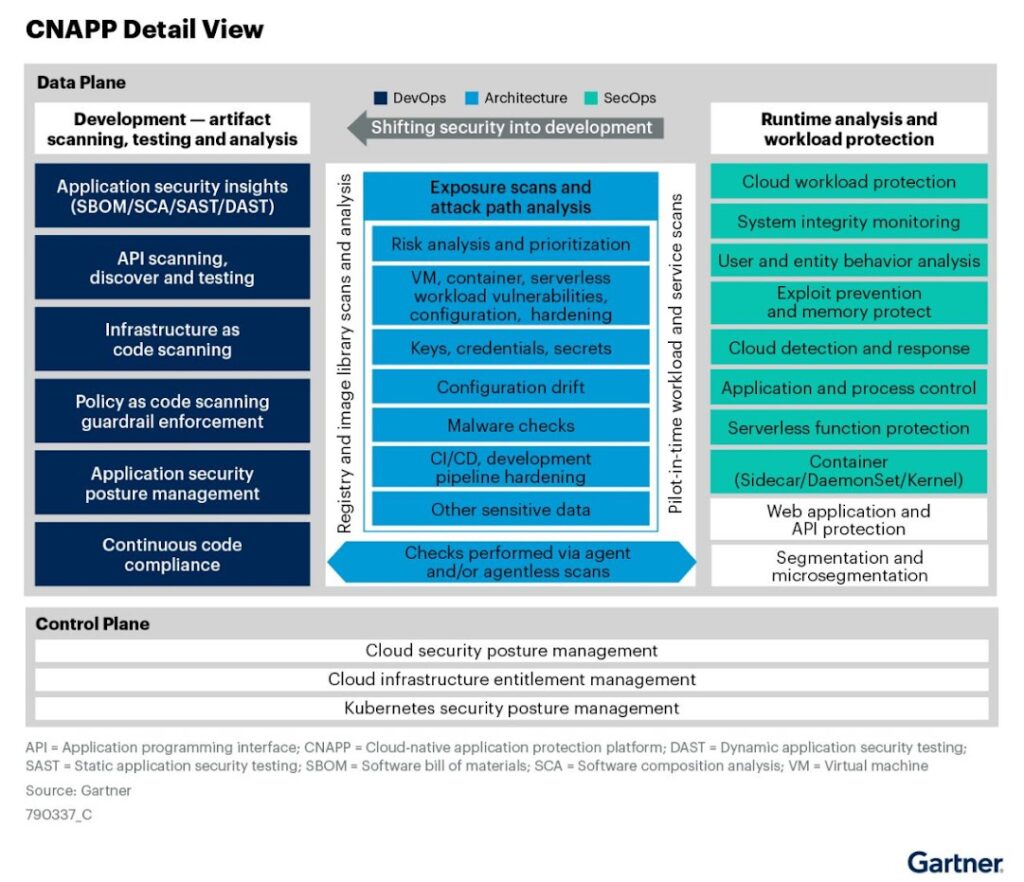
CNAPP consolidates security functions into an enterprise-grade platform architecture with integrated data and control planes:
Integrated Data Plane:
- Development security (SAST/DAST/SCA/secrets management)
- Infrastructure security scanning and policy enforcement
- Runtime workload protection across containers and serverless
- Continuous compliance monitoring and drift detection
Centralized Control Plane:
- Cross-cloud security posture management
- Enterprise policy governance and enforcement
- Consolidated risk analytics and reporting
- Identity and entitlement management integration
Enterprise Value Proposition
Operational Efficiency: Replace 10-15 point solutions with a single platform, reducing integration complexity and vendor management overhead.
Risk-Based Prioritization: Context-aware vulnerability management that correlates development findings with runtime exposure, enabling intelligent risk prioritization at enterprise scale.
Compliance Automation: Built-in frameworks for SOC 2, PCI DSS, and industry-specific regulations with automated evidence collection and reporting.
Cost Optimization: Platform-based licensing models that scale economically with enterprise growth, eliminating per-workload cost spirals.
Enterprise Implementation Framework
Phase 1: Assessment & Pilot Conduct comprehensive tool inventory and select high-impact use cases for initial CNAPP deployment—typically development security scanning and container runtime protection.
Phase 2: Platform Migration Systematically migrate point solutions while maintaining operational continuity. Prioritize integrations with existing SIEM, GRC, and identity management platforms.
Phase 3: Advanced Capabilities Deploy enterprise-specific features including custom policy frameworks, advanced threat hunting, and compliance automation workflows.
Enterprise architects should evaluate CNAPP vendors based on API extensibility, enterprise SSO integration, and support for hybrid/multi-cloud architectures rather than feature checklists alone.